The Boutique Advantage: Why 270 Suites Outperforms 700 in the Luxury Market
Numbers tell stories in real estate, and one of the most revealing numbers in The Unionville's story is this: 270 suites. In a GTA condominium market where the average new development contains 400 to 800 units — and where mega-projects of 1,000 or more suites are increasingly common — The Unionville's decision to limit its suite count to 270 is not a constraint. It is a deliberate, strategic choice that has profound implications for the quality of the resident experience, the financial health of the condominium corporation, and the long-term investment performance of every suite in the building.
Understanding why boutique scale matters — and why it matters more in the luxury segment than anywhere else — requires a look at the economics of condominium living, the sociology of residential communities, and the specific dynamics of the Markham luxury market.
What Is a Boutique Condominium, and Why Does Scale Matter?
The term "boutique" in real estate, as in hospitality and fashion, refers to a scale of operation that prioritizes quality over quantity, personalization over standardization, and intimacy over anonymity. A boutique hotel has fewer rooms than a convention hotel, but each room is better appointed, the service is more attentive, and the experience of staying there is more memorable. A boutique condominium operates on the same principle.
The relationship between scale and quality in residential development is not merely aesthetic. It is structural. When a condominium corporation has 270 unit owners rather than 700, the governance of the corporation is more manageable, the maintenance of the building is more focused, and the sense of community among residents is more genuine. These are not soft benefits; they are factors that directly affect the financial performance of the building and the quality of daily life for its residents.
Maintenance Fee Efficiency: In a boutique building, the fixed costs of building operations — concierge, security, cleaning, landscaping, mechanical maintenance — are spread across a smaller number of units. This can result in higher per-unit maintenance fees than in a larger building, but it also means that the level of service per resident is higher, and that the building's common areas and systems receive more attentive maintenance. The long-term consequence is a building that ages more gracefully, requires less emergency repair expenditure, and maintains its physical quality over a longer period.
Governance Quality: Condominium governance — the process by which unit owners collectively manage their building through a board of directors and a property management company — is one of the most underappreciated factors in the long-term value of a condominium investment. In a large building with hundreds of unit owners, governance is complex, contentious, and often dysfunctional. In a boutique building of 270 units, governance is more manageable, the board has better visibility into the building's condition and needs, and the collective decision-making process is more likely to produce outcomes that serve the long-term interests of all residents.
How Does Boutique Scale Affect the Quality of Amenities?
One of the most common misconceptions about boutique condominium buildings is that their smaller scale means fewer or lower-quality amenities. The Unionville demonstrates that the opposite can be true. When a developer is not trying to serve the needs of 700 or 1,000 residents, they can design amenity spaces that are genuinely fit for purpose rather than merely adequate.
Consider the difference between a fitness centre designed for 270 residents and one designed for 700. In the larger building, the fitness centre must be large enough to accommodate the simultaneous use of dozens of residents — which means more equipment, more space, and more maintenance cost, but also more noise, more congestion, and a less pleasant experience for any individual user. In a boutique building, the fitness centre can be designed to a higher standard of finish and equipment quality, because it serves a smaller population and can be maintained to a higher standard.
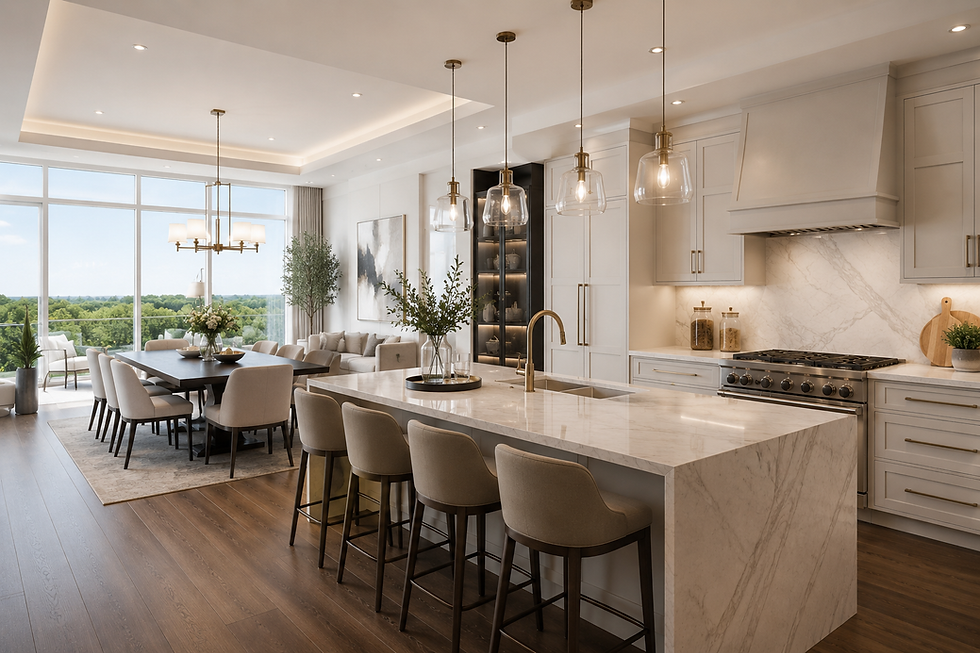
The same logic applies to every amenity space at The Unionville: the STEAM Kids' Club, the Aspire Workspace, the Tee Time virtual golf simulator, the Music Studio. Each of these spaces has been designed for a specific community of 270 residents, not for an anonymous mass of 700. The result is amenity spaces that feel curated and intentional rather than generic and overcrowded.
The Lobby Experience: The two-storey grand lobby at The Unionville — with its fireplace lounge and hotel-inspired arrival sequence — is an amenity that would be difficult to maintain at the standard inCAN has set if it were serving 700 residents rather than 270. The intimacy of the lobby experience — the sense that this is a building where the concierge knows your name and the lobby is never crowded — is a direct function of the building's boutique scale.
What Are the Investment Implications of Boutique Scale?
The investment case for boutique luxury condominiums is well-supported by market data from comparable markets in Canada and internationally. Several dynamics converge to make boutique buildings outperform larger developments over the long term.
Scarcity Premium: In any market, scarcity drives value. There are, by definition, fewer boutique luxury condominiums than mass-market high-rises, and the supply of boutique units in any given neighbourhood is extremely limited. In Angus Glen — a community where the prevailing residential typology is the detached home and the townhouse — a boutique mid-rise of 270 suites is a genuinely rare product. This scarcity creates a premium that is reflected in both rental rates and resale values.
Tenant Quality: Boutique luxury buildings attract a higher-quality tenant pool than mass-market developments. The demographic that is drawn to a building like The Unionville — high-income professionals, executives, empty-nesters downsizing from large homes — is a demographic that pays rent reliably, maintains the suite in excellent condition, and tends to stay for longer periods. Lower tenant turnover means lower vacancy costs for investors and lower wear-and-tear on the suite.
Resale Differentiation: In a building of 700 identical suites, the resale market is highly competitive. When a unit comes to market, it is competing directly with dozens of similar units in the same building, and the pricing pressure this creates can be significant. In a building of 270 suites — particularly one where the Grand Collection offers genuine personalization — each unit has a more distinct identity, and the resale market is less competitive. This differentiation supports stronger resale pricing and faster sale times.
Building Condition Over Time: Buildings that are well-maintained from the outset tend to remain well-maintained, because the culture of quality established in the early years of a building's life tends to persist. Boutique buildings, with their more manageable governance structures and more focused maintenance programs, are more likely to maintain this culture of quality over the long term. The result, over a 10–20-year horizon, is a building that looks and functions significantly better than a comparable mass-market development of the same age.
How Does The Unionville Compare to Larger Markham Developments?
The Markham new condominium market includes a range of product types, from the boutique mid-rise of The Unionville to large master-planned communities with hundreds of units across multiple towers. Understanding where The Unionville sits in this landscape — and why its positioning is strategically advantageous — requires a direct comparison.
Feature | The Unionville | Typical Large GTA Development | Mass-Market High-Rise |
Suite Count | 270 | 400–800 | 800–1,500+ |
Building Height | 10 storeys | 20–40 storeys | 40–70+ storeys |
Maintenance Fee Character | Premium service, focused maintenance | Variable, often rising | Cost-driven, often declining service |
Governance | Manageable, community-oriented | Complex, often contentious | Highly complex |
Amenity Quality | Curated, purpose-designed | Adequate, high-volume | Generic, overcrowded |
Resale Differentiation | High (personalization, scarcity) | Moderate | Low (commodity) |
Tenant Quality | Premium demographic | Mixed | Highly variable |
Long-Term Value Retention | Strong (scarcity + quality) | Moderate | Variable |
The comparison is not intended to suggest that larger developments are without merit — they serve important roles in the housing market and offer price points and unit types that boutique buildings cannot. But for buyers and investors who are specifically seeking the luxury residential experience, the boutique scale of The Unionville is a fundamental advantage, not a limitation.
What Is the Market Outlook for Boutique Luxury Condos in Markham?
The broader GTA condominium market is navigating a period of adjustment in 2026, with elevated inventory levels and softer pricing in the mass-market segment. However, the boutique luxury segment — buildings of fewer than 300 units in established, high-demand communities — has demonstrated significantly greater resilience than the broader market.
According to the Toronto Regional Real Estate Board's 2026 market forecast, the GTA average price range is expected to be between $1 million and $1.03 million, with boutique luxury developments in communities like Angus Glen continuing to command premiums well above this average. The York Region Housing Market Outlook published by RE/MAX in late 2025 projected a 4% price appreciation for the region in 2026, with the luxury segment outperforming the broader market.
The supply side of the boutique luxury equation is equally favourable. The combination of high land costs, complex planning requirements, and the difficulty of achieving the design standards required for a genuine luxury product means that new boutique luxury developments in Angus Glen are extremely rare. The Unionville is, at present, the only boutique luxury mid-rise under development in the community — a supply constraint that will support both rental rates and resale values for the foreseeable future.
Frequently Asked Questions About The Unionville's Scale and Investment Case
Why does The Unionville have only 270 suites?
The 270-suite count is a deliberate design choice by inCAN Developments, reflecting their conviction that boutique scale is fundamental to the luxury residential experience. A smaller building allows for more focused maintenance, more attentive service, more curated amenity spaces, and a stronger sense of community — all of which contribute to a higher quality of daily life and stronger long-term investment performance.
Are maintenance fees higher in boutique buildings?
Boutique buildings typically have higher per-unit maintenance fees than larger developments, because fixed operating costs are spread across fewer units. However, this higher fee is associated with a higher level of service, more attentive maintenance, and a building that ages more gracefully — factors that support long-term value retention and resident satisfaction.
How does boutique scale affect resale values?
Boutique luxury buildings tend to achieve stronger resale values than mass-market developments because of scarcity (fewer comparable units on the market), differentiation (personalized suites with distinct identities), and building condition (better maintained over time). In a building of 270 suites, each unit is more distinctive and the resale market is less competitive than in a building of 700 or more.
What is the rental demand like for boutique luxury condos in Angus Glen?
Angus Glen has been identified as one of the most coveted rental areas in the GTA, with strong demand from high-income professionals, executives, and families who value the neighbourhood's exceptional schools, safety, and amenities. Boutique luxury buildings in this community command rental premiums over comparable mass-market developments, driven by the quality of the product and the scarcity of supply.
What is the starting price at The Unionville, and when is completion?
Suites at The Unionville start from the mid-$600,000s, with an anticipated completion of Winter 2028. For current pricing and availability, contact the sales team at sales@theunionville.ca or visit theunionville.ca.
The Unionville Condominium is located at 9332 Kennedy Road, Markham, Ontario. For floor plans, pricing, and investment information, visit theunionville.ca or contact the sales team at (416) 575-5558.


Comments