The Architectural Renaissance: How Martin Baron's Vision Is Redefining Markham's Skyline
There is a particular kind of building that announces itself not through height or spectacle, but through the quiet authority of its proportions. It is the kind of structure that, decades after its completion, still commands attention — not because it chases trends, but because it was designed to transcend them. The Unionville Condominium, rising at the intersection of Kennedy Road and 16th Avenue in Markham's prestigious Angus Glen neighbourhood, is precisely that kind of building.
At the heart of this architectural ambition is Martin Baron, the principal architect behind Baron Nelson Architects, a firm whose portfolio is defined by a singular conviction: that architecture must respond to its context, honour its history, and serve its residents with both beauty and function. His vision for The Unionville is not simply a design brief executed with competence. It is a considered statement about what luxury residential architecture in the Greater Toronto Area can and should aspire to be.
What Is the "White Grid" and Why Does It Matter?
The most immediately recognizable feature of The Unionville's exterior is its integrated aluminum white grid — a structural and aesthetic device that defines all four sides of the building's base and gives the facade its distinctive, rhythmic character. To understand why this choice is significant, it helps to understand what it is reacting against.
The dominant visual language of GTA condominium development over the past two decades has been glass: floor-to-ceiling curtain walls that prioritize transparency and the illusion of lightness. While this aesthetic has its merits, it has also produced a generation of towers that are, in the candid assessment of many architects and urban critics, visually interchangeable. Drive along any major arterial road in Markham, Mississauga, or North York, and the sameness becomes apparent — a skyline of glass boxes differentiated only by their height and the colour of their spandrel panels.
Martin Baron's response to this condition is the White Grid. By introducing a structured aluminum framework that organizes the facade into a series of defined bays and panels, Baron creates a building that reads as composed rather than continuous. The grid provides visual weight and permanence — qualities associated with the classical European architectural tradition that Baron cites as a primary influence. The divided-light thermal windows set within this grid reinforce the classical reference: they recall the multi-pane windows of Georgian and Italianate architecture while delivering the thermal performance that modern building codes require.
The choice of white aluminum is equally deliberate. White has long been associated with civic and institutional architecture of the highest order — from the marble temples of ancient Greece to the rendered facades of Regency London. In the context of Angus Glen, a neighbourhood characterized by the refined, low-rise residential architecture of its master-planned communities, the White Grid positions The Unionville as a building of civic significance: a landmark that belongs to its community rather than imposing upon it.
How Does The Unionville Relate to the Angus Glen Neighbourhood?
One of the most persistent criticisms of mid-rise and high-rise condominium development in established suburban communities is the problem of contextual dissonance — the jarring visual and spatial disconnect between a new tower and the existing fabric of the neighbourhood around it. Martin Baron's design for The Unionville addresses this challenge with unusual thoughtfulness.
The building's height of 10 storeys (118 feet) is a deliberate choice. It is tall enough to offer residents meaningful views of the Markham skyline and the adjacent nature preserve, but human-scaled enough to maintain a respectful relationship with the surrounding streetscape. In a neighbourhood where the prevailing residential typology is the detached home and the townhouse, a 10-storey building can feel like a natural punctuation mark — a vertical accent that marks a significant intersection — rather than an alien intrusion.
This sensitivity extends to the building's relationship with the ground plane. The two-storey grand lobby, inspired by the arrival sequences of elite European hotels, creates a generous, publicly legible base that anchors the building to the street. Rather than presenting a blank podium or a utilitarian parking structure at grade — the unfortunate default of many GTA condominium developments — The Unionville offers a lobby experience that is genuinely architectural: a space of arrival, of decompression, of transition from the urban street to the private sanctuary of the residences above.
The lobby's fireplace lounge, detailed with the kind of custom craftsmanship more commonly associated with a private club or a boutique hotel than a condominium building, reinforces this message. It tells residents and visitors alike that the standards of quality maintained within this building are not the standards of the mass market. They are the standards of a developer — inCAN Developments — that has spent its formative years building ultra-luxury custom homes in Vancouver's West Shaughnessy neighbourhood, where the expectations of discerning clients are among the highest in the country.
What Are the Signature Terrace Suites and Sky Lofts?
Among the most distinctive residential typologies at The Unionville are the Signature Terrace Suites and the Sky Lofts — suite categories that represent the fullest expression of Baron's commitment to the integration of indoor and outdoor living.
The Signature Terrace Suites occupy the lower levels of the building and are distinguished by their extended private outdoor terraces — generous, landscaped spaces that function as true outdoor rooms rather than the token balconies that characterize most condominium developments. These terraces are designed to facilitate the kind of outdoor living — al fresco dining, private gardening, morning coffee with a view of the nature preserve — that is typically associated with the detached home rather than the condominium. For buyers who love the idea of a low-maintenance urban lifestyle but are unwilling to sacrifice outdoor space, the Terrace Suites represent a genuinely compelling proposition.
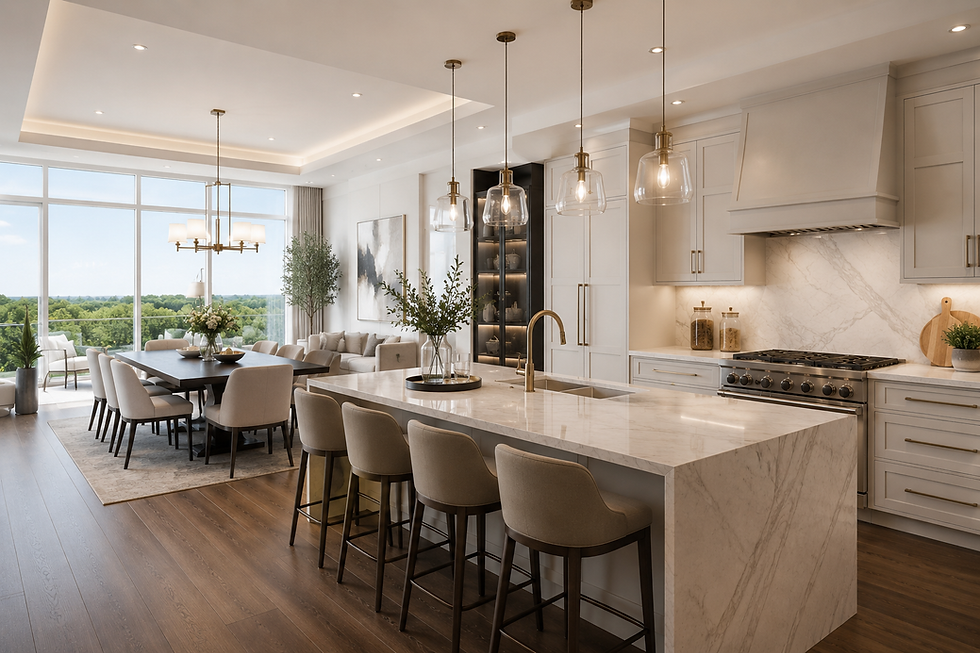
The Sky Lofts, positioned at the upper levels of the building, offer a different but equally compelling experience. With 10-foot ceiling heights (compared to the already-generous 9-foot standard throughout the building), expanded glazing, and panoramic views of the Markham skyline and the emerging York Downs nature preserve, the Sky Lofts are designed for residents who want the full drama of elevated urban living. The combination of height, volume, and natural light in these suites creates an atmosphere that is closer to a penthouse in a boutique hotel than to a standard condominium unit.
How Does The Unionville Compare to Other Markham Developments?
The Markham luxury condominium market is not without competition. Projects such as Pangea Condos and Markham GOLD have established themselves as significant players in the broader Markham new-development landscape. However, a careful analysis of the architectural differentiation reveals that The Unionville occupies a genuinely distinct position.
Feature | The Unionville | Typical GTA High-Rise | Mass-Market Condo |
Building Height | 10 storeys (human scale) | 30–50+ storeys | 15–25 storeys |
Facade System | Integrated aluminum White Grid | Glass curtain wall | Brick/glass hybrid |
Lobby | Two-storey hotel-inspired grand lobby | Single-storey lobby | Functional entry |
Outdoor Living | Extended terraces + Sky Lofts | Standard balconies | Juliet balconies |
Suite Count | 270 (boutique) | 400–800+ | 200–400 |
Architectural Concept | Classical Italian / contextual | Contemporary/generic | Varied |
The boutique scale of 270 suites is, in itself, an architectural statement. It means that Baron's design vocabulary — the White Grid, the grand lobby, the extended terraces — can be applied consistently and without compromise across the entire building. There are no "economy" suites tucked behind the parking structure, no inferior exposures sacrificed to maximize unit count. Every residence in The Unionville is a full expression of the architectural vision.
Why Does Architecture Matter for Long-Term Property Value?
This is a question that sophisticated buyers and investors ask with increasing frequency, and the evidence from comparable markets is compelling. Research consistently demonstrates that buildings with distinctive, high-quality architectural design maintain their value more effectively over time than generic developments, for several interconnected reasons.
First, distinctive architecture creates scarcity value. There will only ever be one building in Angus Glen with the White Grid facade, the two-storey fireplace lobby, and the 270-suite boutique scale. That singularity cannot be replicated by future developments, which means that The Unionville's architectural identity becomes more valuable, not less, as the neighbourhood matures.
Second, high-quality architecture attracts a higher-quality tenant and buyer pool. The demographic that is drawn to a building like The Unionville — educated, high-income, design-conscious — is precisely the demographic that maintains buildings well, participates constructively in condominium governance, and sustains strong resale values over the long term.
Third, and perhaps most importantly, architecture that is rooted in classical principles ages more gracefully than architecture that follows contemporary trends. The White Grid's reference to Italian classical order is not a nostalgic gesture; it is a strategic choice to align The Unionville with a design tradition that has proven its durability across centuries. When the glass-and-steel towers of today's GTA skyline begin to show their age, The Unionville will still look exactly as it was intended to look: timeless.
Frequently Asked Questions About The Unionville's Architecture
Who is the architect of The Unionville Condominium?
The Unionville was designed by Martin Baron of Baron Nelson Architects, a firm recognized for its award-winning approach to contextual, luxury residential architecture. Baron's philosophy emphasizes the responsiveness of architecture to its surrounding environment, ensuring that each building he designs feels like a natural and meaningful addition to its community.
What is the "White Grid" facade?
The White Grid is the building's signature exterior feature — an integrated aluminum framework that organizes the facade into a series of defined bays, creating a visual rhythm that references classical Italian architectural principles. It is both a structural element and an aesthetic statement, providing the building with a sense of permanence and craftsmanship that distinguishes it from the glass-curtain-wall towers that dominate the GTA skyline.
How tall is The Unionville Condominium?
The building stands 10 storeys tall, reaching approximately 118 feet. This height was chosen deliberately to maintain a human-scaled relationship with the surrounding Angus Glen neighbourhood while providing residents with meaningful views of the Markham skyline and the adjacent York Downs nature preserve.
What makes the lobby of The Unionville special?
The two-storey grand lobby is inspired by the arrival sequences of elite European hotels. It features a fireplace lounge with custom artisanal detailing, creating a space of genuine architectural quality that sets the tone for the entire building. Unlike the functional, utilitarian lobbies common in mass-market condominiums, The Unionville's lobby is designed as a destination in its own right.
What are the Signature Terrace Suites?
The Signature Terrace Suites are a distinctive residential typology at The Unionville, characterized by extended private outdoor terraces that function as true outdoor rooms. They are designed for residents who want the convenience of condominium living without sacrificing the outdoor living experience typically associated with a detached home.
How does The Unionville's architecture support long-term property values?
Distinctive, high-quality architecture creates scarcity value, attracts a high-quality resident community, and ages more gracefully than trend-driven design. The White Grid's reference to classical Italian principles aligns The Unionville with a design tradition that has proven its durability over centuries, ensuring that the building will remain visually compelling and contextually appropriate for decades to come.
The Unionville Condominium is located at 9332 Kennedy Road, Markham, Ontario, in the Angus Glen community. For floor plans, pricing, and registration information, visit theunionville.ca or contact the sales team at sales@theunionville.ca.


Comments